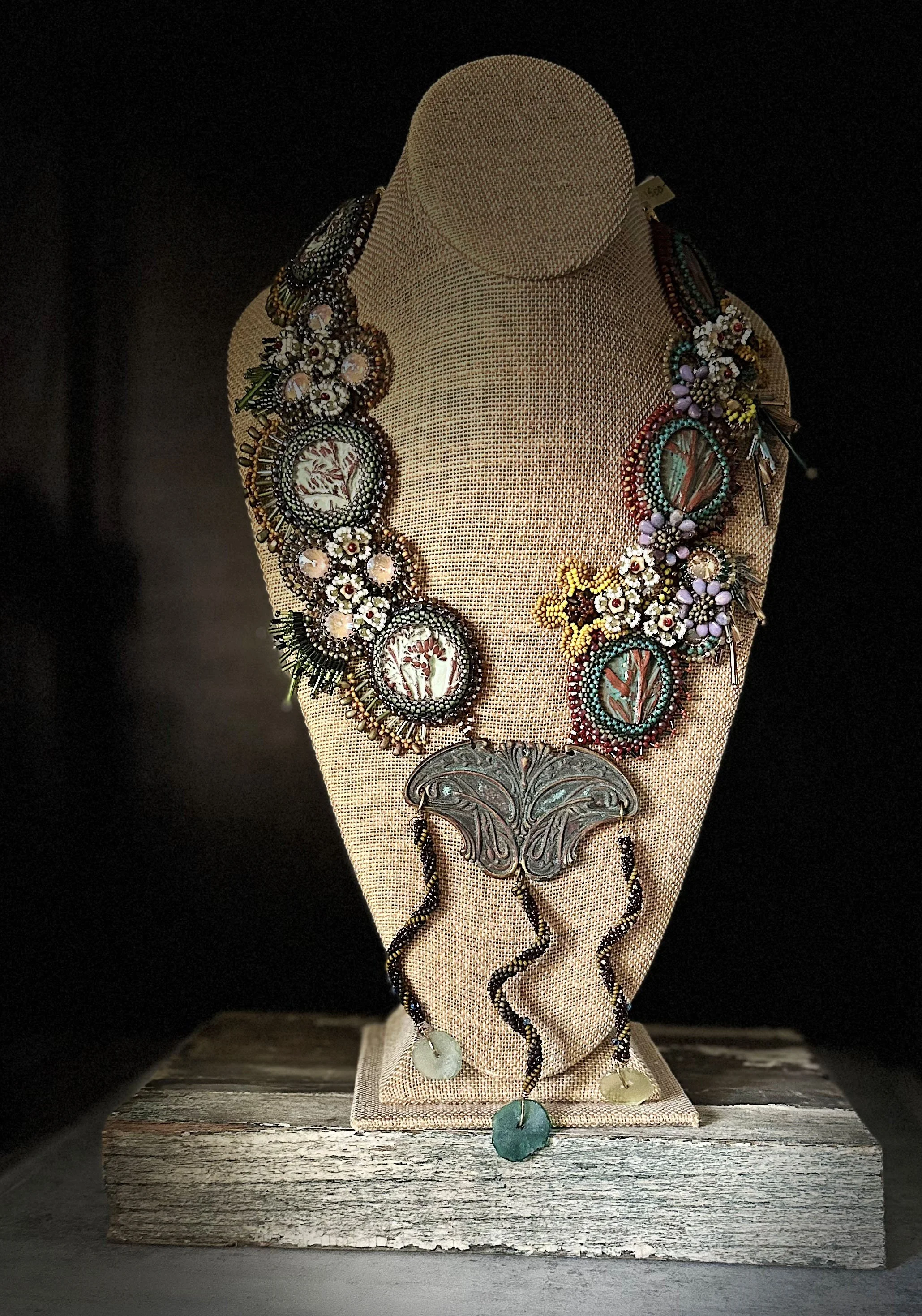
Helen O’Donnell Spotlight
Helen O’Donnell
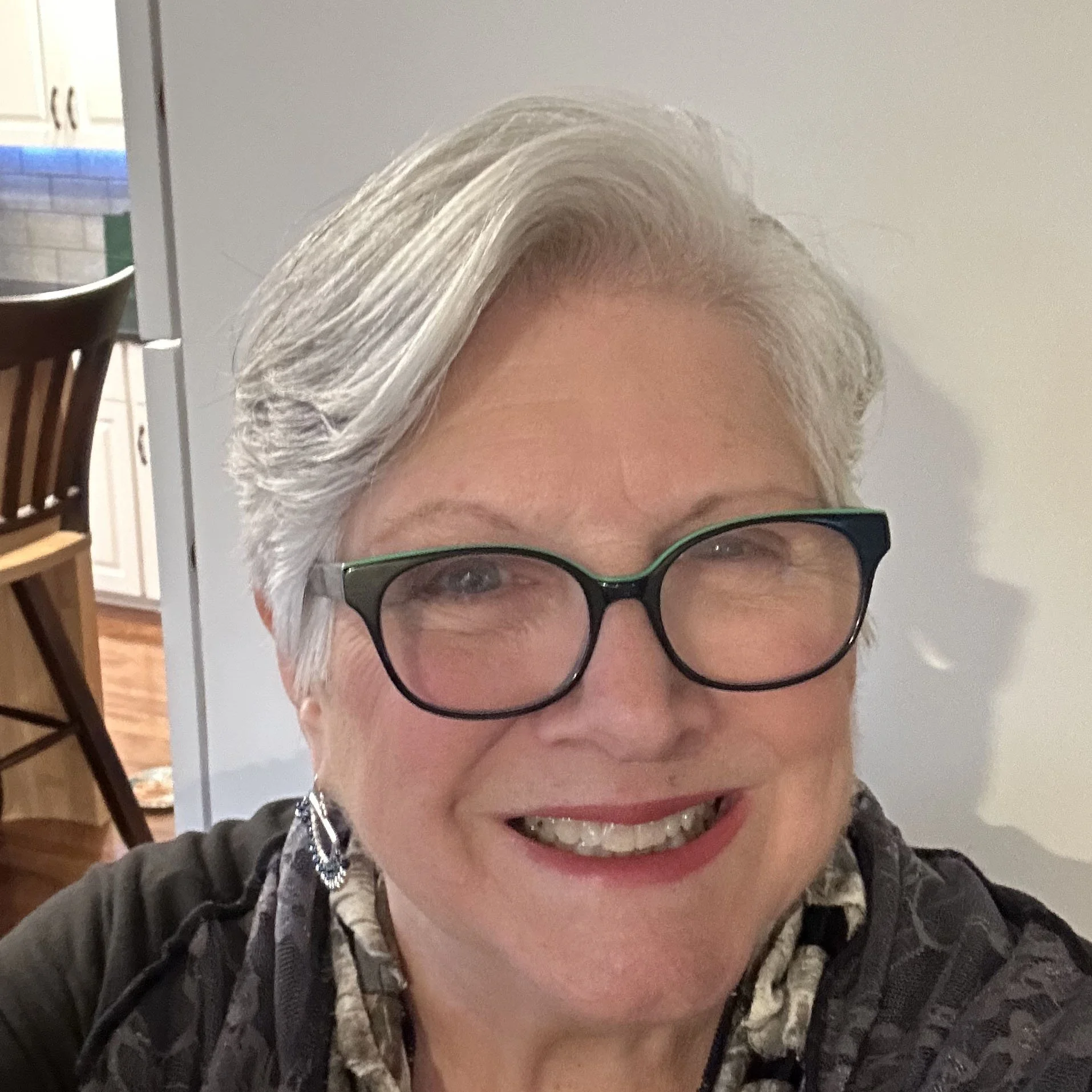
Written by Sage Szucs, June, 2026
Inspired by her studies in natural resources at the College of Forestry at NC State in Raleigh, North Carolina, Helen O’Donnell is a creative maker specializing in jewelry-making and shadow boxes.
“I consider myself a creative maker for most of what I do. Some works I call ‘art,’ some I don't; so I wear two hats, in a sense. For those creations that don't make my high bar for calling ‘art,’ it's because I don't believe that I have created something that will foster a conversation between the viewer and me. One of the key elements of art–to me–is that the artist has to present a perspective that influences the viewer to interpret it based on their own experiences. In turn, the artist then learns something about that person, and communication happens, all because of art! Most of my jewelry doesn't cut the mustard, for me, to be defined as art; but my shadow boxes and some of my competition necklaces that are created to reflect the world around me, I would consider art. This is simply my viewpoint. I know others have different opinions, and that's okay.”
Creating has always been something she has found herself doing. From the age of seventeen, she worked with charcoal and oil paints and practiced knitting and sewing until she chose to pursue a career in accounting. In her forties, she went back to school at the College of Forestry at NC State in Raleigh, North Carolina. This experience has informed a lot of her jewelry pieces, specifically “When Bison Roamed the Plains”, as it is inspired by a tall grass prairie on her property.
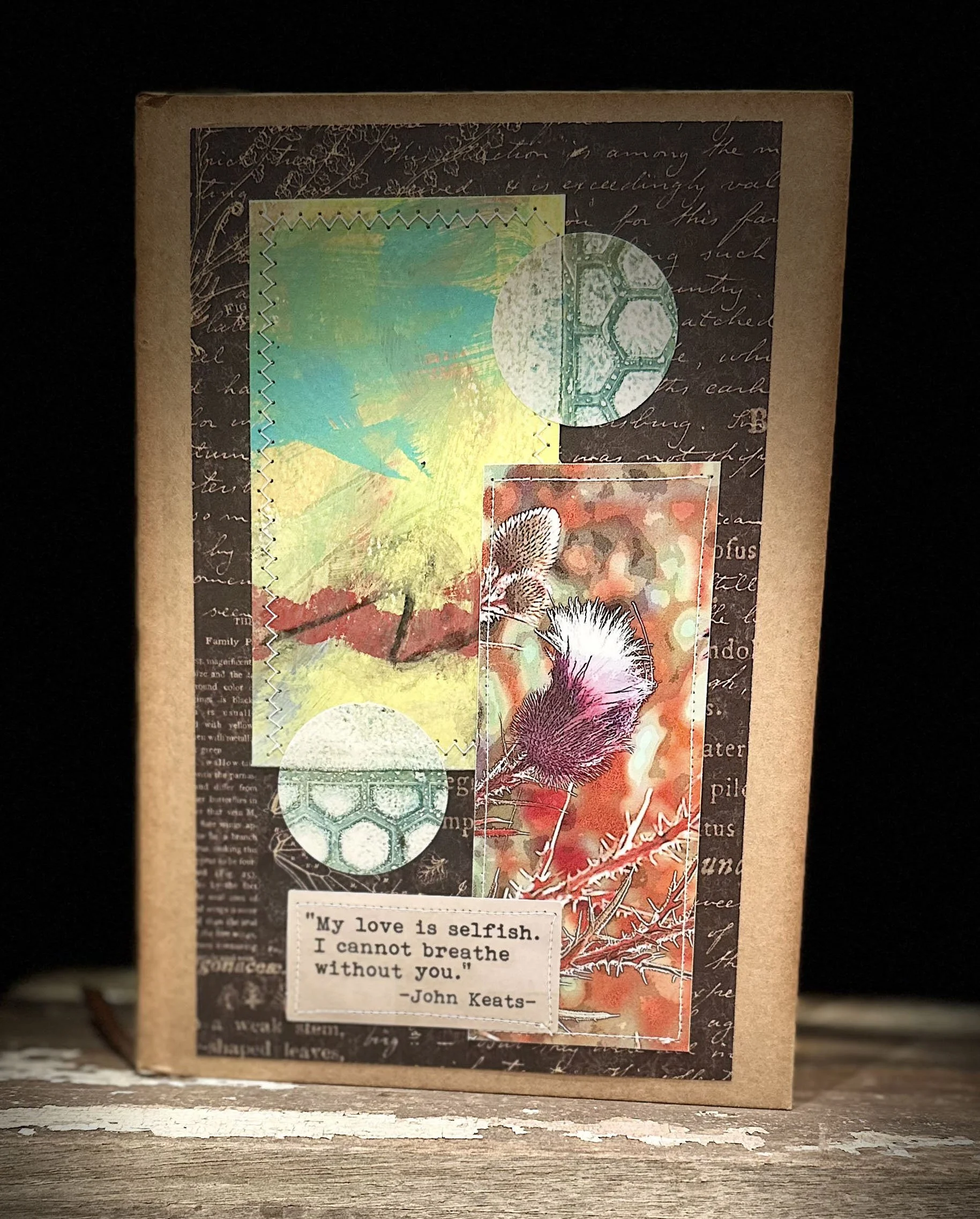
Helen discovered beads in 1999 on a trip to Greece. She met a woman making ceramic pendants, decided to buy some of her work, and brought them back to the United States, selling them on Amazon and eBay. This started a small online bead business for her that led to her practice in the art of beading and jewelry-making. She now mainly creates free-form sculptural-like necklaces, such as “When Bison Roamed the Plains” and jewelry for local galleries.
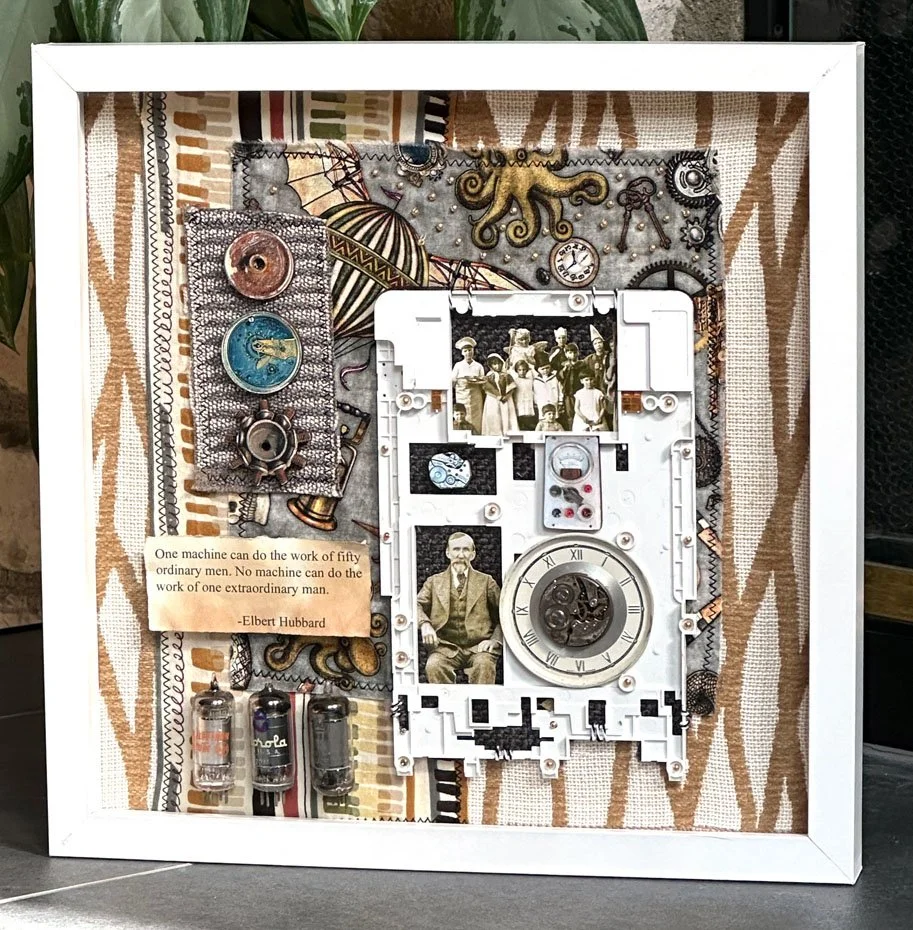
Shadow boxes became a second medium of expression for her about six years ago after her retirement. She appreciates this art form in a different way compared to the beads, as she is more inspired by the world around her and the human condition, and is able to share her thoughts more explicitly and directly.
“It just grew out of a need more than anything to express myself and to kind of get conversations going with people, and when I do shows, it definitely [gets] conversations going. And some people liked what I had to say, some people didn't.”
Helen enjoys bouncing back and forth between these two mediums, as one fulfills the logical side of her, and the other feeds her creative side.
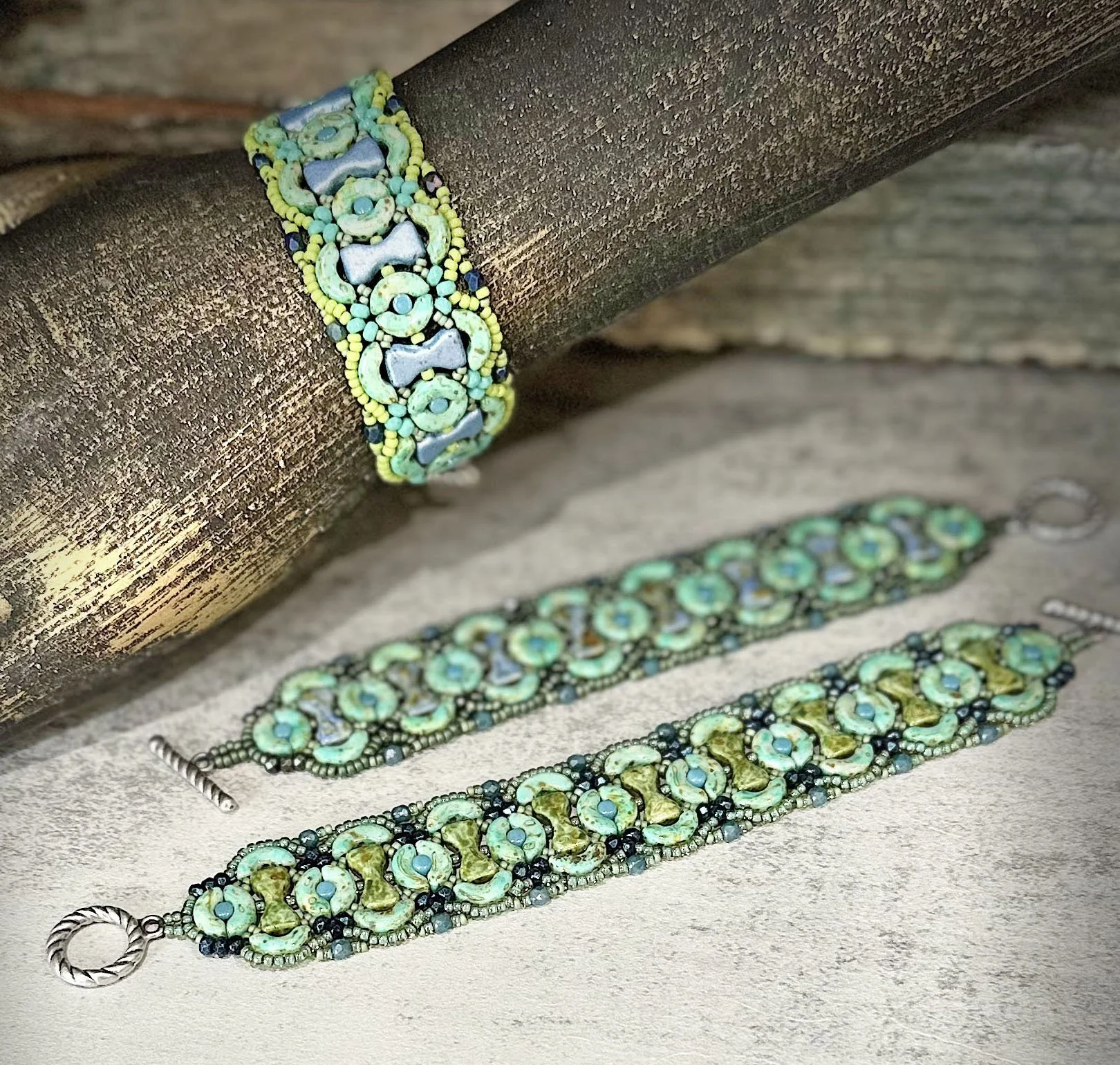
“I would say the shadow boxes...satisfy a need for more literal or overt messaging, and the beading is more of solace because I know beads and I know how they go together. I know my limitations. I know what I can do, what I can't do, and I get into the zen moment of fitting.”
Although both of her artistic mediums bring her joy, she shared, “Self doubt rears its ugly head with almost everything I make.” With successes and repeating customers, she has gotten more confident in her abilities and her work, but even if she had not, she finds it more important to stay true to her own artistic voice than to comply with what is popular at the time.
“Validation is always welcomed, but I don't feel like anything hinges on validation. I like it–it's nice to get it–but if I don't get it, it's okay. I'm still going to make what I make. It's not going to change my direction.”
Beyond her own life, Helen believes that the arts are integral to personhood, connection, and the human experience. They bleed into every aspect of our lives.
“No matter where you live, and no matter what your station in life is, the arts speak to the human condition, and they connect us all. I think that we'd have a life that would be far paler, less colorful, less inspiring, less everything without the arts. I mean, I can't imagine living a day without something artistic in my life. My house is covered with art. Every wall has got paintings on it, and it gives me peace to look at them. I think it's important to foster the arts among young people, because it exercises creativity, and I don't think there's any problem facing the youth of today that can't benefit from a creative life. Whether it's solving the climate crisis, or health issues, or a COVID vaccine, or whatever: you need creativity for that, and the arts is where you get creativity. I don't want to see it out of schools. I don't want people being discouraged from the arts. I think creativity feeds your soul, and I think it's an essential part of being a human being, personally.”